
Saguache County Court Records After Jail Arrest
The Saguache County arrest-to-court path has a custody step and a court step. The official Saguache County Sheriff's Office page says Saguache County inmates are now held at the Rio Grande Sheriff's Department in Del Norte. That means current jail custody, bond availability, and release timing usually start with Rio Grande County Jail. Once the prosecutor files a case in Saguache County, court records after a jail arrest move into the Colorado Judicial Branch system for the 12th Judicial District.
The 12th Judicial District Attorney's Office serves Saguache, Alamosa, Conejos, Costilla, Mineral, and Rio Grande Counties. Its charging role is important because a jail booking charge is not always the final court charge. A deputy may book a person on a warrant or probable-cause allegation. The prosecutor may then file a complaint or information, amend a count, reduce a count, dismiss a count, or decline a charge that appeared at booking.
The custody record and the court record should be read together but kept separate. Current booking, release, and jail status belong with Saguache County jail inmate records. Booking photos and photo-request limits belong with Saguache County jail mugshots. Court records after an arrest are the filed case, docket events, court orders, bond orders, and final disposition.
Find Saguache County Court Arrest Records
Saguache criminal cases are handled through Saguache Combined Court in Colorado's 12th Judicial District. The court location page lists Saguache Combined Court at 501 4th Street, P.O. Box 197, Saguache, CO 81149, phone 719-655-2522, email saguacheclerk@judicial.state.co.us, and weekday business hours. The public docket is the free starting point for court records after an arrest, but the docket is not a document database. It shows case and event information. Copies of complaints, informations, dispositions, and registers of action require the Judicial Branch record request path.
The Colorado Judicial Branch docket search has the search fields needed to narrow a Saguache County case after charges are filed.
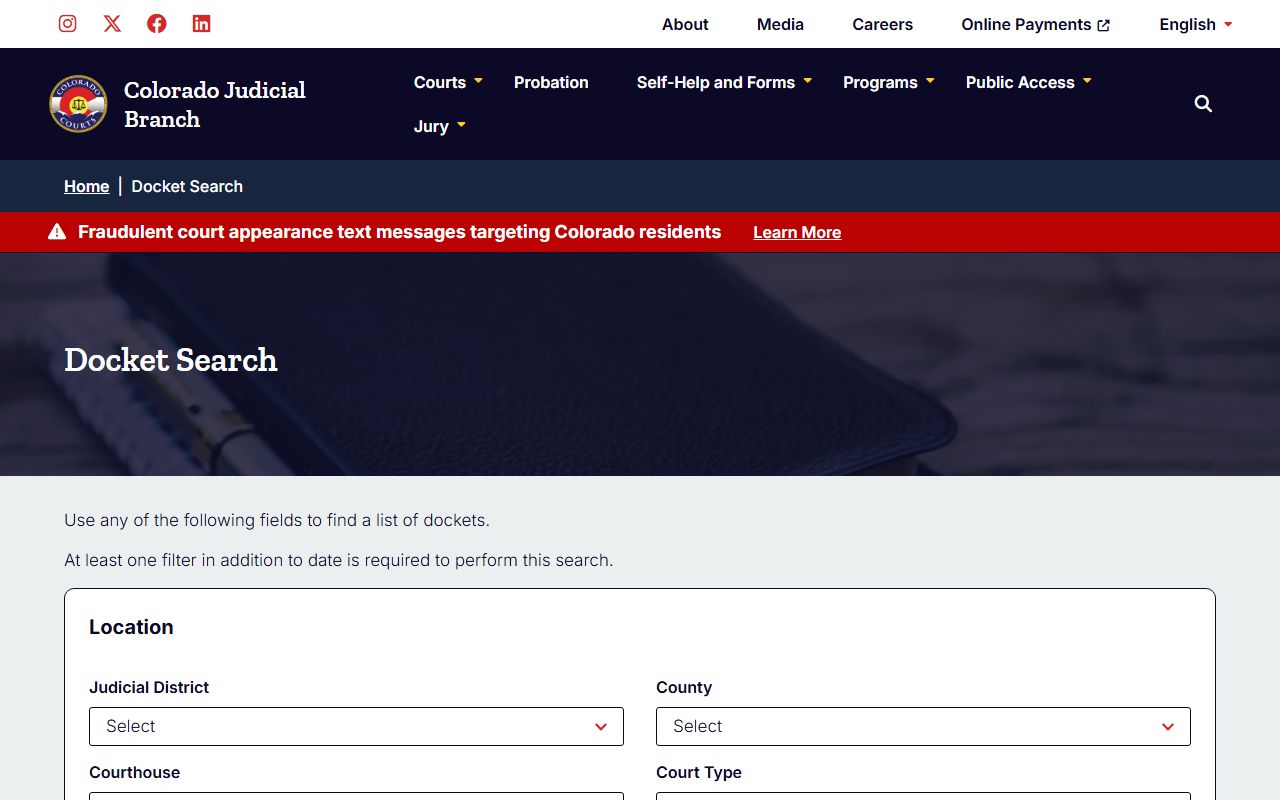
The docket form is useful after the case exists. It should not be treated as proof that a person is still in custody at Rio Grande County Jail.
| Search Field | How to Use It | Saguache County Note |
|---|---|---|
| Judicial District | Choose the district filter. | Use 12th Judicial District for Saguache cases. |
| County | Select the filing county. | Use Saguache County for local state cases. |
| Courthouse | Filter by court location. | Saguache Combined Court appears as the local court. |
| Case Number | Enter year, class, and sequence when known. | Helpful after bond papers or court notices are issued. |
| Party Search | Search by individual first and last name. | Use full legal name and spelling from jail or court papers. |
| Date Range | Use with another filter. | The docket requires at least one filter beyond date. |
- Start with the district, county, courthouse, name, or case-number filters. A date-only search is not enough.
- Open the matching case entry and read the case number, court type, parties, and docket events.
- Compare the docket charge list with the jail or bond information, because booking charges can differ from filed charges.
- Use the record/document request form when full documents, certified copies, or a register of action are needed.
Saguache County Charging Documents
Court records after a jail arrest usually begin with a formal charging paper. Colorado Judicial Branch request options for criminal records include Complaint/Information, Disposition/Sentence Order, Protection Order, Ticket, and Register of Action. The Register of Action is described in the research as a brief explanation of the case, including charges, sentences, and minute orders. That makes it a useful document when a person needs a compact view of how a Saguache County court case moved after arrest.
| Document | Who Files It | What It Does |
|---|---|---|
| Complaint | Prosecutor or charging authority | Starts many criminal cases and lists alleged offenses filed in court. |
| Information | Prosecutor | Formally states charges, often in felony matters or amended filings. |
| Indictment | Grand jury | Charges offenses through a grand-jury process, usually in more serious matters. |
The Colorado Judicial Branch record/document request form is the path for court copies when the public docket does not show the document itself.
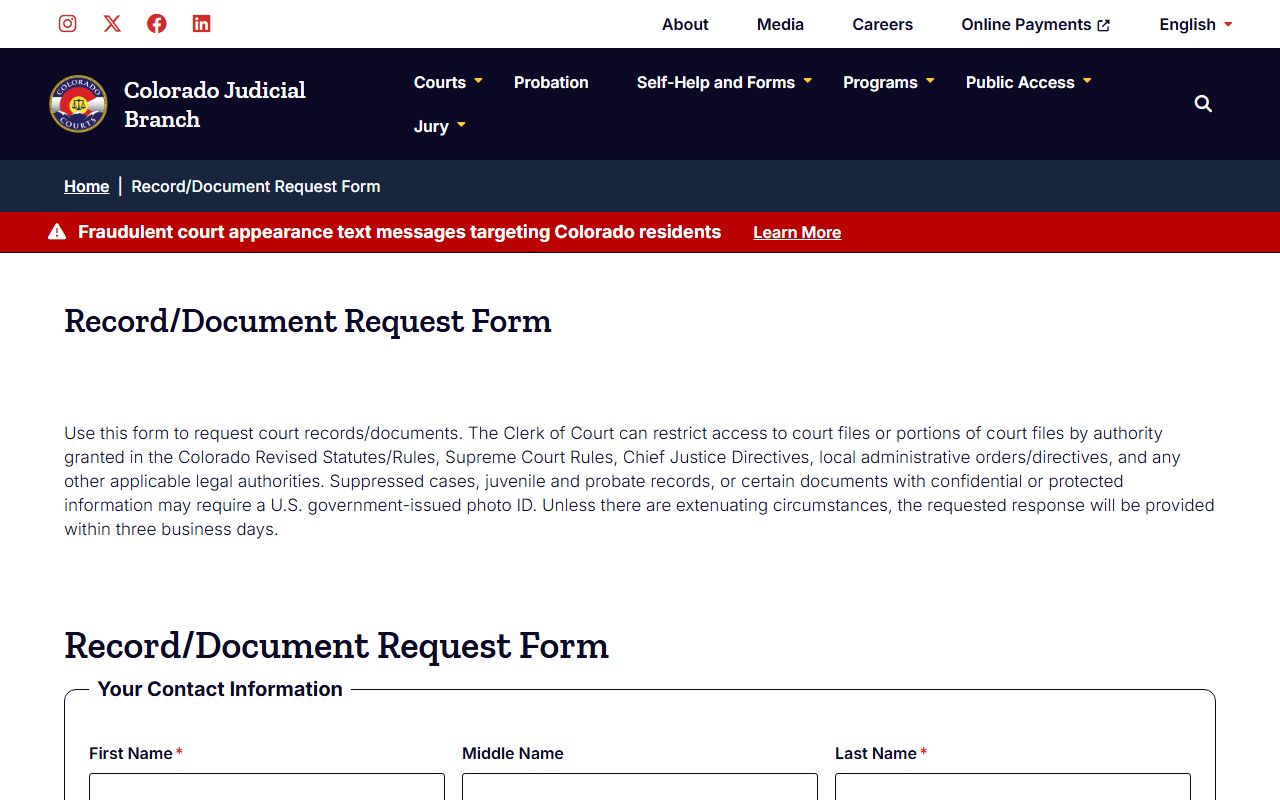
The request form asks for requester contact details, case information if known, county or location of records, party information, and the requested document category.
Saguache County Charge Status
Charge status can change several times after a Saguache County jail arrest. A case may start with one set of allegations, then shift after review by the 12th Judicial District Attorney, a plea agreement, a hearing, or a court order. The status of each count matters. One charge may be dismissed while another remains pending. A reduced count may replace a higher-level charge. A disposition may end the case but still leave bond, protection-order, restitution, probation, or sentence terms to check.
| Status | Plain Meaning | What to Check |
|---|---|---|
| Pending | The charge is still open in court. | Next hearing, bond status, and active conditions. |
| Amended | The filed charge was changed by prosecutor or court action. | Whether the new count changed level, code, or facts alleged. |
| Reduced | A lower charge replaced or resolved a higher one. | Plea, sentence order, and final conviction wording. |
| Dismissed | The count was dropped or ended without conviction on that count. | Whether the whole case or only one count was dismissed. |
| Disposed | The court entered an outcome. | Disposition, sentence order, fines, probation, or custody term. |
Note: A court charge can remain pending even after the person is released from jail.
Saguache County Arrest Bond Records
Bond after a Saguache County arrest has two practical tracks. The jail track answers whether the person can be released now and what steps are accepted at the holding facility. The court track answers what bond order was entered, what conditions apply, and whether a later hearing changed the terms. For Saguache inmates held at Rio Grande County Jail, call 719-657-4000 for current custody and release instructions. For the court order, use Saguache Combined Court or the Judicial Branch records request form.
| Bond Type | Meaning | Local Research Note |
|---|---|---|
| Personal recognizance | Release on a promise to appear, often with conditions. | Local criteria were not published in the sheriff materials reviewed. |
| Cash bond | Money posted as security for court appearance. | Call Rio Grande County Jail for current payment instructions. |
| Surety bond | A licensed bond agent posts bond under a private agreement. | No official local bondsman list is used here. |
| No-bond hold | Ordinary release is not available at that stage. | Can involve warrants, probation, parole, court order, or another agency hold. |
Saguache County Warrant Court Records
No official Saguache Sheriff active warrant list and no official Rio Grande Sheriff active warrant search page were located in the official county pages reviewed. A warrant may still lead to an arrest and jail booking. The safe access path is to call Saguache Sheriff at 719.655.2544 for Saguache-origin warrant questions, call Rio Grande County Sheriff at 719-657-4000 if someone was arrested and booked, and use the court docket or Saguache Combined Court for court-issued bench warrant context.
Warrants should be handled with care. An arrest warrant authorizes arrest. A bench warrant often follows failure to appear or violation of a court order. A fugitive warrant or hold can keep a person in local jail pending transfer. A probation or parole hold can block release even when a new case appears to have bond. The sheriff can confirm custody status, but the court controls many warrant and bond orders.
Saguache County Charges vs Convictions
A charge is an accusation. A conviction is a legal outcome after a plea, verdict, or judgment. This difference is central to court records after a jail arrest because jail booking charges, prosecutor-filed charges, and final convictions can all differ. A person may be arrested and never convicted. A person may be convicted of a reduced charge. A count may be dismissed while a different count ends in a sentence.
| Record Type | Charge | Conviction |
|---|---|---|
| Stage | Allegation after arrest or filing. | Final court outcome after plea, verdict, or judgment. |
| Where It Appears | Jail records, complaint, information, docket, or warrant. | Disposition, sentence order, register of action, and criminal history. |
| Meaning | Not proof of guilt. | Proof that the court entered a conviction on that offense. |
| Can Change? | Yes, charges may be amended, reduced, or dismissed. | Changes usually require appeal, post-conviction action, sealing, or other court order. |
Saguache County Court Records Law
Colorado public access rules use more than one legal track. General county records may fall under CORA, but criminal justice records are handled under the Colorado Criminal Justice Records Act. Court records are maintained by the Judicial Branch, while sheriff booking records, arrest records, and many jail records are criminal justice agency records. The Colorado Judicial Branch access guide says case documents are not available directly from the public website, so the docket and the court request form work together.
Key Statutes:
C.R.S. 24-72-301 et seq. governs Colorado criminal justice records held by law-enforcement and criminal justice agencies.
C.R.S. 24-72-201 et seq. is Colorado's general open-records framework, subject to exemptions and special criminal-record rules.
C.R.S. 24-72-305.5 governs access to booking photographs, which are different from court charge documents.
Saguache County Sealed vs Expunged Records
Sealing belongs to the record-access stage, not the live jail-custody stage. A sealed old case does not prove that a current booking, warrant, or hold is hidden. Colorado Judicial Branch provides a Seal My Case starting point for people trying to seal eligible criminal records, including arrest or no-charges forms and conviction sealing forms. The research also notes that CBI must receive a signed sealing order before it updates its own records.
The Colorado Judicial Branch Seal My Case page lists arrest, no-charges, conviction, municipal, and auto-sealing forms.
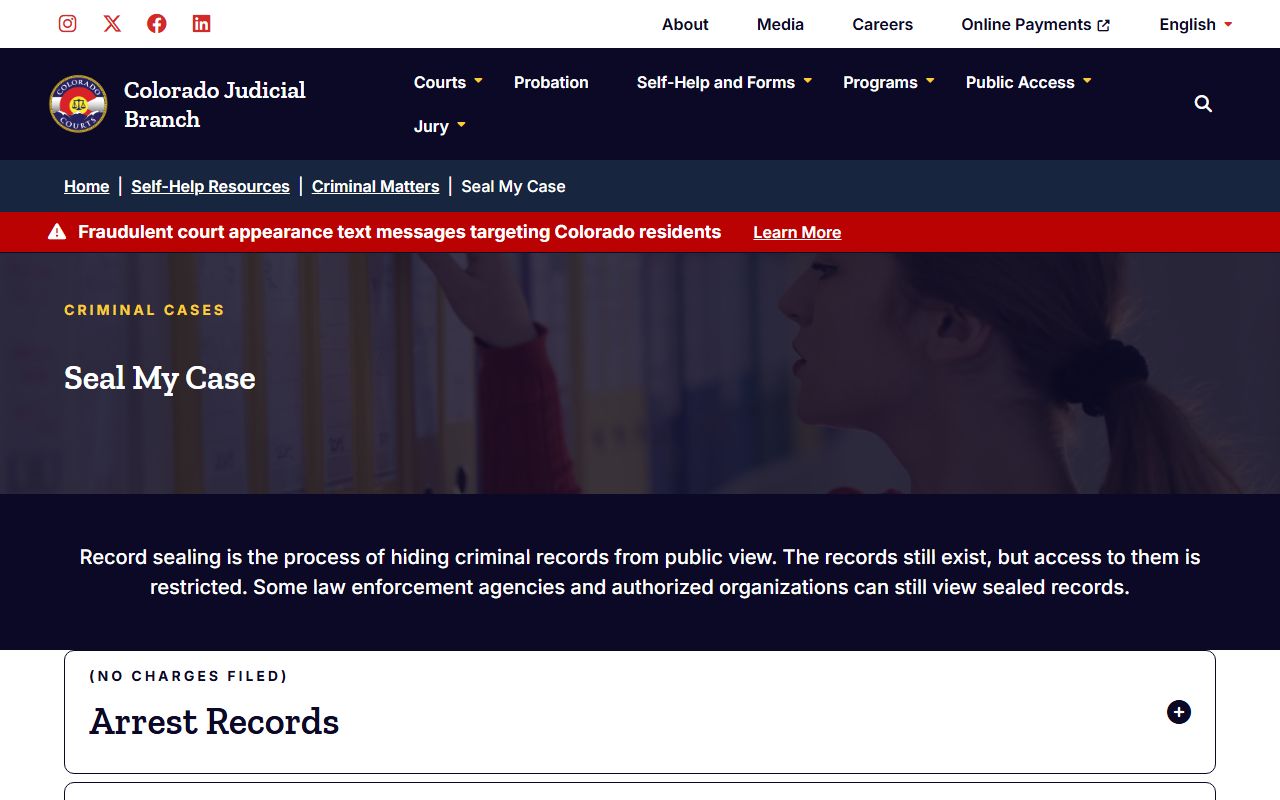
Use sealing resources for eligible old court records, not as a way to confirm current Rio Grande County Jail custody.
| Record Action | What It Means | Saguache County Access Effect |
|---|---|---|
| Sealed | Public access is limited by court order or automatic sealing rule. | The public may not see the case, but authorized agencies may still have limited access. |
| Expunged | Record treatment is more restrictive and often tied to specific eligibility rules. | Colorado materials discuss sealing and expunging together, but eligibility is case-specific. |
| Not sealed | The case remains available subject to court access rules and redactions. | Docket search and record requests may still be available. |
Restricted Saguache County Arrest Court Records
Some Saguache County court records after an arrest may be restricted, redacted, or unavailable to the general public. Reasons can include sealing, juvenile status, victim or witness privacy, protection-order limits, ongoing proceedings, statutory restrictions, or court rules. A docket hit also does not mean every paper in the case can be copied. The court may require a formal request, a fee, a certified-copy request, or redaction review before release.
The Judicial Branch request form lists copy and service fees in the research: $0.25 per page, $20 for certified or exemplified copies per document, $5 for a name search, actual cost for off-site file retrieval, and $30 per hour for research or redaction after the first hour, assessed in 15-minute increments. Fee waivers may apply when required under court directive or statute.
Important: This resource is not a consumer reporting agency and cannot be used for employment, housing, credit, insurance, or other FCRA-covered screening decisions.